St Piran: Cornwall's Patron Saint and His Magical Discovery
About this story
St Piran, Cornwall's patron saint, miraculously arrived on a millstone and discovered tin smelting, shaping Cornwall's identity. His legacy is celebrated annually on March 5th.
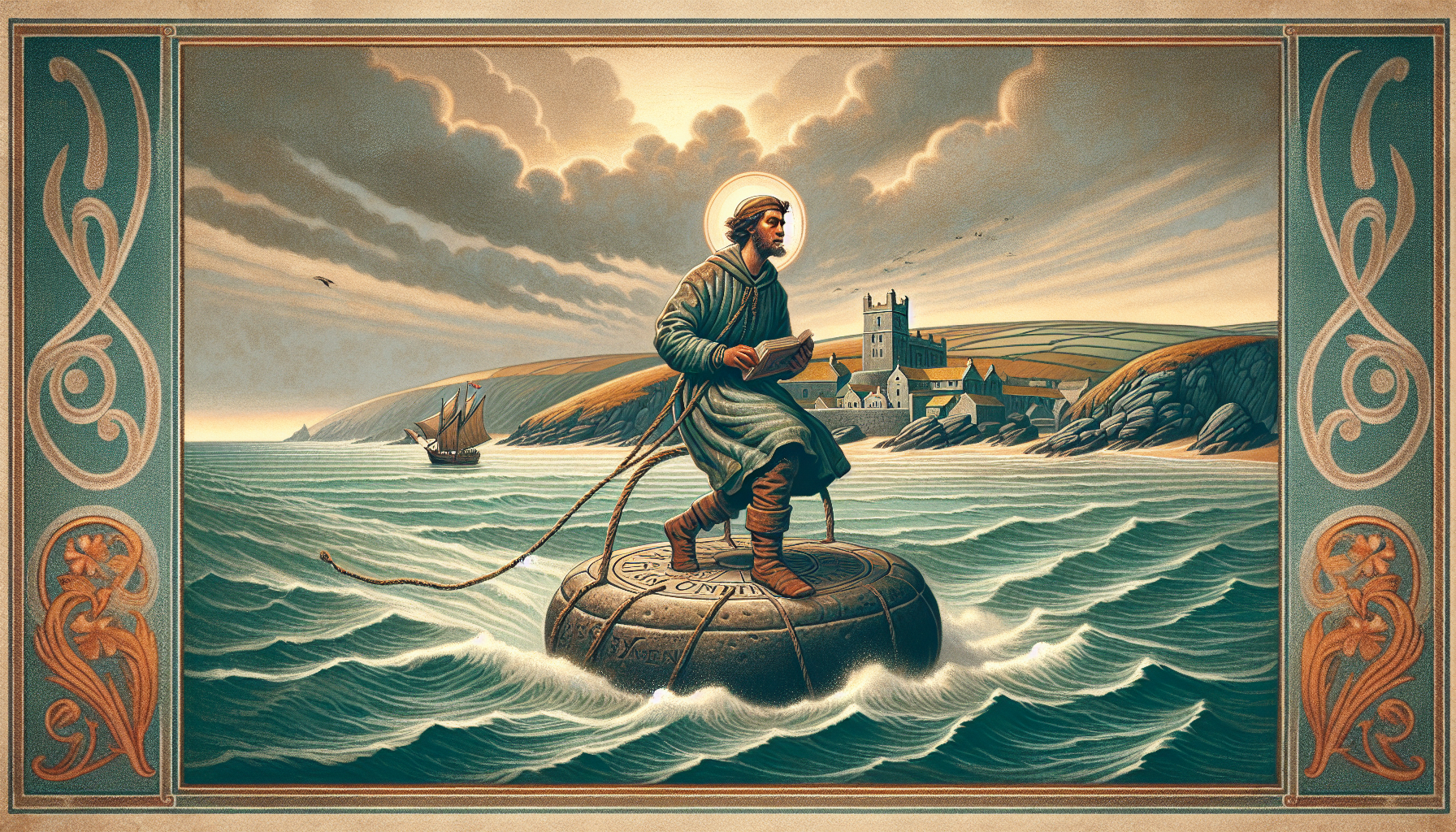
Cornwall's patron saint arrived, legend says, floating across the Irish Sea on a millstone. St Piran had been thrown from a cliff by Irish pagans who objected to his Christian preaching. When he survived by clinging to the stone, they decided this was one miracle too many and cast him out to sea.
The millstone didn't sink. Instead, it carried Piran safely to the Cornish coast near Perranporth, where he stepped ashore on the beach that now bears his name: Perran Sands.
Piran built a small oratory in the dunes — the remains of which can still be visited — and began preaching to the Cornish. But his greatest contribution to Cornwall came by accident.
One evening, Piran built a fire using black stones from the beach. As the fire grew hot, a white liquid began to flow from the stones and pool at his feet. Piran had discovered tin smelting. The black stones were tin ore, and the white metal was pure tin.
The St Piran's flag — a white cross on a black background — represents this discovery: white tin emerging from black ore. It has flown over Cornwall ever since, the oldest national flag in continuous use in the United Kingdom.
Every March 5th, thousands of people walk to St Piran's Oratory on the dunes above Perranporth to celebrate their patron saint. They carry the black and white flag and sing Cornish songs. In recent years, the parade has grown so large that it has become one of the biggest annual events in Cornwall.
Kernow bys vyken — Cornwall forever. St Piran's gift endures.
Source: Celtic saints hagiography, Cornish church historical records, and Perranporth heritage archives. Traditional religious and cultural heritage in the public domain.
Comments (0)
Sign in to join the conversation
No comments yet. Be the first to share your thoughts!
More stories you might enjoy
The Hurling of St Columb: The Wildest Game in Britain
Every Shrove Tuesday and the following Saturday, the town of St Columb Major transforms into a battleground for one of the oldest and most violent sports in Bri...

The Great Eclipse of 1999: When Cornwall Went Dark
On August 11th, 1999, Cornwall experienced the first total solar eclipse visible from mainland Britain since 1927. For two minutes and four seconds, day became ...
The Cornish Pasty: A Miner's Portable Feast
The Cornish pasty is more than food — it's a piece of engineering designed for the most dangerous workplace in the world: the tin mine. The crimped crust tha...